
A ₹999 order is not ₹999 of profit. To see what the order actually contributes, subtract the product’s landed cost, marketplace and fulfilment charges, advertising, packaging and the expected cost of returns or failed deliveries. The result is a contribution per order—not necessarily your final business profit.
This worked example is for an Amazon.in seller. Amazon’s fees depend on product category, price, size, weight and fulfilment channel. Its published fee schedule was updated effective September 7, 2026, so use your Seller Central estimate for the exact SKU before changing a price.
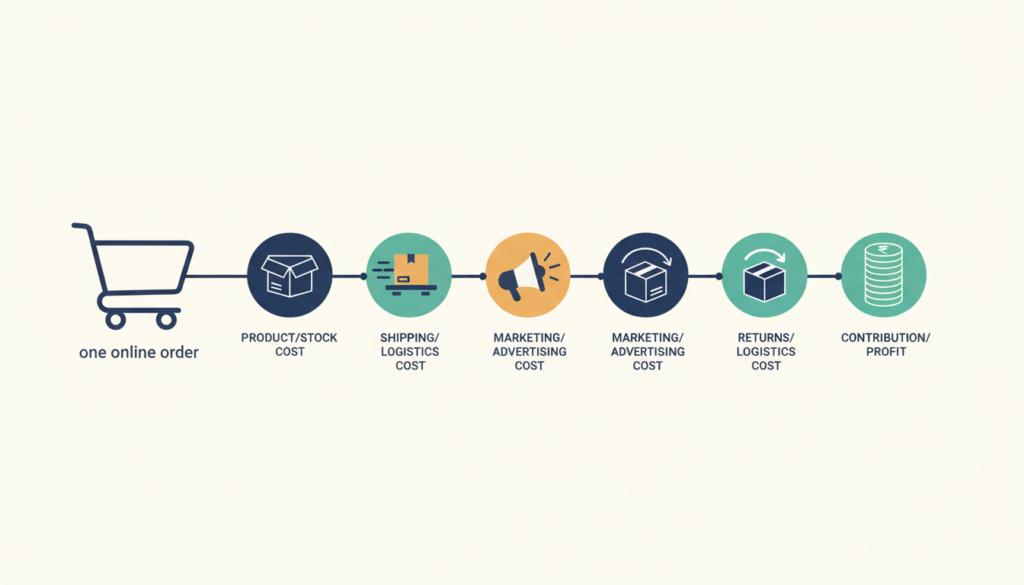
The quick formula
Contribution per delivered order = net sales value − landed product cost − marketplace and fulfilment costs − advertising − packaging and inbound costs − expected return/RTO loss.
Use net sales value after seller-funded discounts and excluding output GST. If your customer-facing price includes GST, first separate the tax using the rate that applies to your product. Do not treat GST collected for the government as sales income.
A ₹999 worked example
The figures below are illustrative assumptions, not Amazon’s quoted charges for a particular product. For this example, ₹999 is the seller’s net sales value after discounts and output GST have been accounted for.
| Per-order item | Example amount |
|---|---|
| Net sales value | ₹999 |
| Landed product cost | − ₹350 |
| Marketplace and fulfilment costs, including any non-recoverable fee tax | − ₹170 |
| Advertising allocated to this order | − ₹80 |
| Packaging and inbound handling | − ₹25 |
| Expected return/RTO loss reserve | − ₹30 |
| Contribution before fixed costs | ₹344 |
Try a quick margin stress test
Starting from the illustrative ₹344 contribution above, see how two cost changes affect the result. These are simple what-if calculations, not forecasts.
| Changed assumption | Contribution per order |
|---|---|
| Starting example | ₹344 |
| Ad cost rises from ₹80 to ₹105 | ₹319 |
| Return/RTO reserve rises from ₹30 to ₹60 | ₹314 |
| Both cost increases | ₹289 |
Try your own values: every extra rupee of variable cost reduces contribution by one rupee, unless another input changes too.
In this scenario, the seller has ₹344 left from the order to contribute toward fixed business costs and profit. The example does not include salaries, rent, software subscriptions, income tax or other overheads, so ₹344 is not the same as take-home profit.
What to include in each line
- Net sales value: the amount attributable to the sale after discounts, with output GST separated. Keep refunds and seller-funded coupons consistent with the way your settlement report records them.
- Landed product cost: what it costs to get one saleable unit ready to sell, including purchase cost and inbound freight or preparation. Use a consistent GST treatment; eligible input tax credit may change your economic cost.
- Marketplace and fulfilment costs: use the fee estimate for the SKU and fulfilment method you actually use. Referral rates can vary by category, and fulfilment charges can depend on size, weight and destination. Amazon also states that its fee schedule amounts are exclusive of GST, so account for the tax on fees according to whether you can claim eligible credit.
- Advertising: divide relevant ad spend by the orders you attribute to those campaigns. If you use total orders instead, label it as blended ad cost per order; don’t compare it with campaign-attributed figures as though they were the same measure.
- Packaging and inbound handling: include seller-paid packaging, prep and shipping into the fulfilment network when these costs are not already included elsewhere.
- Expected return/RTO loss: estimate the average unrecovered cost per order across a representative period. One simple starting point is return/RTO rate multiplied by average unrecovered cost per returned or failed order. Include reverse logistics or damaged stock only if those costs fall on you, and avoid counting the same charge twice.
Why a return reserve matters
A delivered order can look profitable while a batch of returns or return-to-origin (RTO) shipments erases the margin. Suppose 5% of orders create an average unrecovered cost of ₹600 each. The reserve is ₹30 per order (0.05 × ₹600). Replace both assumptions with your own recent order and settlement data. The right rate will differ by product, channel and customer mix.
Get the actual Amazon fee estimate
Check the product’s fee category and fulfilment option in your seller account, then compare the estimate with actual settlement reports. Amazon’s Revenue Calculator can estimate proceeds for fulfilment options. Review the current Amazon.in selling fee schedule as well; it lists category and channel-specific charges and notes the September 7, 2026 update. Estimates can differ from your final settlement.
Turn this into your own calculator
- Enter the net sales value for the SKU.
- Enter landed product cost and the exact marketplace/fulfilment estimate.
- Add advertising per order, packaging and inbound cost.
- Use a return/RTO reserve based on your own records.
- Subtract the costs to get contribution per order, then multiply by expected delivered orders.
- Compare that contribution with fixed monthly costs before deciding whether the product is viable.
Recalculate when your selling price, fee schedule, ad costs or return rate changes. Keep the assumptions visible so you can tell whether a margin improvement came from a real cost change or just a more optimistic estimate.
Example for education only. It is not a tax or accounting calculation. Verify product GST treatment and marketplace deductions against current official guidance and your own settlement statements; consult a qualified professional for advice on your business.